
A Bell’s palsy treatment physical therapy guide should explain when rehab may help. It should list common exercises.
It should also explain when medical care comes first. Bell’s palsy can affect facial movement, eye closure, speech, eating, and facial expressions.
At ITNYCPT in New York City, Keith Chan, a New York State-licensed physical therapist, serves as the subject-matter expert for this topic. The goal of care is to support safe facial rehabilitation, not force fast recovery.
Key Takeaways
- Bell’s palsy physical therapy may help improve facial movement, eye closure, symmetry, and control when exercises are matched to the recovery stage.
- Medical evaluation should come first because stroke, Ramsay Hunt syndrome, infection, and other conditions can cause similar facial weakness.
- Bell’s palsy exercises should be gentle, specific, and controlled. Short sessions with mirror feedback are usually safer than forceful or repeated movements.
- Recovery timelines vary. Some people improve within 2–3 weeks, while others need 3–6 months or longer, especially with severe weakness or long-term symptoms.
- Physical therapy may include facial movement assessment, neuromuscular re-education, facial massage, home exercises, reassessment, and guidance to avoid unwanted movements.
Does Physical Therapy Help Bell’s Palsy?
Yes. Physical therapy may help some people with Bell’s palsy improve facial movement, control, and coordination.
A physical therapist can assess how the facial nerve affects blinking, smiling, speaking, and eye closure. The treatment plan should match the person’s symptoms, timing, eye safety, and ability to perform muscle movements without strain.
Research is still developing. A systematic review of physical therapy for facial nerve paralysis suggests facial exercises may help some patients.
They may help most when weakness persists or recovery is incomplete. Therapy for Bell’s palsy works best when it is specific, gentle, and adjusted over time.
When to Seek Medical Care First
Bell’s palsy can look like other conditions. A medical provider should check for sudden facial weakness because stroke, infection, Ramsay Hunt syndrome, facial nerve palsy, and other conditions can cause similar symptoms; symptoms such as dizziness, balance changes, or headache may also require careful screening, as discussed in concussion physical therapy. Safe treatment for Bell’s palsy starts with the right diagnosis.
Seek urgent care if facial weakness occurs with:
- Arm weakness, confusion, severe headache, dizziness, or trouble speaking
- Vision changes, balance problems, new numbness, or worsening weakness
- Severe ear pain, fever, rash near the ear, or symptoms on both sides of your face
Eye protection also matters early. If weakness affects more than the face, medical evaluation is important because some neurologic conditions, including those discussed in Guillain-Barré syndrome physical therapy, can involve broader weakness and require different care.
If you cannot close your eyes fully, the eye can dry out or become irritated. A medical provider may recommend lubricating drops, taping, or other steps to protect the eye.
What Bell’s Palsy Does to the Face
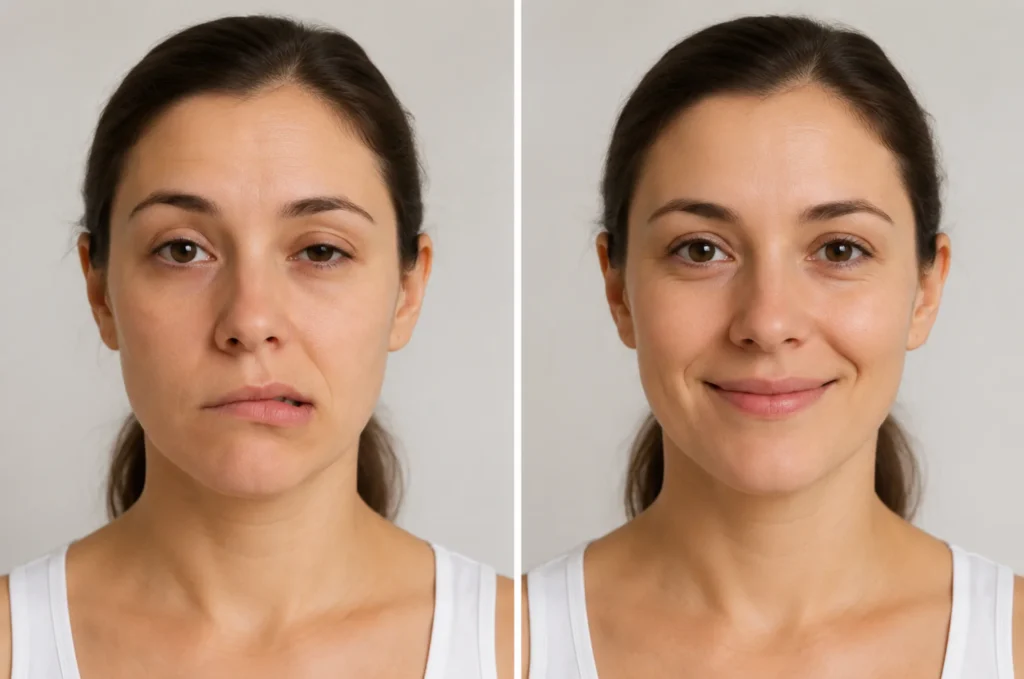
Bell’s palsy affects the facial nerve, which controls many muscles on one side of the face. This can make it hard to raise the eyebrow, blink, smile, pucker the lips, or move the corner of your mouth. The two sides of your face may also move unevenly.
Facial nerve paralysis does not always mean permanent damage. Some people recover within weeks or months, while others develop long-term tightness, weakness, or unwanted movements. These differences explain why the same exercise list does not fit every person.
What Physical Therapy Can Do
Physical therapy for facial nerve paralysis often starts with a detailed evaluation. The physical therapist reviews symptom timing, diagnosis, eye closure, daily limits, and goals. The therapist may ask you to smile, blink, raise your eyebrows, close your eyes, pucker your lips, and relax your face.
Facial physical therapy may include:
- Facial movement assessment
- Mirror feedback
- Neuromuscular re-education
- Gentle home exercises
- Facial massage for tightness when appropriate
- Reassessment across therapy sessions
Neuromuscular re-education means retraining the nerves and muscles to work together. In Bell’s palsy, this usually means small and controlled movements, not strong or repeated force. The goal is better timing, symmetry, and control.

Bell’s Palsy Physical Therapy Exercises
Bell’s palsy PT exercises should feel gentle and controlled. They differ from general strength exercises because facial exercises require greater precision than power exercises. The best exercises for Bell’s palsy depend on the stage of recovery and the extent of active movement present.
When to Start Bell’s Palsy Exercises
A medical provider should confirm the diagnosis before facial exercises begin. If movement is very limited, early work may focus on awareness, relaxation, eye protection, and assisted motion. If some movement is present, a therapist may begin low-effort practice with mirror feedback.
Do not rush into hard repetitions. Starting too aggressively can increase tension or reinforce poor movement patterns. Exercise timing should follow symptom response rather than a fixed online schedule.
Bell’s Palsy Face Exercises
Bell’s palsy face exercises often focus on small movements around the eyes, mouth, cheeks, and eyebrows. The goal is to move only the target area while keeping the rest of the face relaxed. Stop if the motion causes pain, pulling, or strong tightness.
Common examples include:
- Eyebrow lift: Gently raise the eyebrow, then relax fully.
- Soft eye closure: Slowly close the eye without squeezing.
- Small smile: Lift the corner of your mouth without pulling the neck.
- Lip pucker: Bring the lips forward with light effort.
- Cheek control: Try a small cheek lift while keeping the eye relaxed.
- Mouth corner control: Move the mouth slightly to one side, then return to neutral.
These exercises should not feel like a workout. A small, clean motion is better than a large motion with strain. If the eye closes when you smile, or the mouth pulls when you blink, the exercise may need to change.
Therapy for Bell’s Palsy Guidelines
Therapy for Bell’s palsy should follow a simple order. Confirm the diagnosis. Protect the eye. Assess facial movement. Choose exercises. Reassess often.
A treatment plan should change as movement improves or new symptoms appear. Care should also account for pain, fatigue, stress, sleep, health history, and daily demands.
Avoid forceful facial movements. Chewing gum, aggressive stretching, repeated hard smiling, or trying to “push through” weakness may increase tension. The face often responds better to slow, precise practice.
Electrical Stimulation for Bell’s Palsy
Some people search for Bell’s palsy physiotherapy treatment, electrical stimulation, because they want to speed recovery. Electrical stimulation uses a device to trigger or assist a muscle response. Evidence is mixed, and there is no standard answer for every case.
Electrical stimulation may be discussed in selected cases, but a qualified clinician should guide it. Poor timing or poor settings may reinforce unwanted movements or confuse facial control. It should not replace active facial rehabilitation or medical care.
What Helps Bell’s Palsy Go Away Faster?
No exercise or device can guarantee faster recovery. Bell’s palsy recovery depends on nerve healing, symptom severity, diagnosis, timing of treatment, eye care, health history, and adherence to the plan. The most useful approach is usually early medical care, safe eye protection, and appropriate rehab when needed.
Home exercises can help when they are appropriate for the person’s condition. More exercise is not always better. Short, accurate practice often works better than long, forced sessions.
Can I Exercise with Bell’s Palsy?
Yes. Many people can continue general physical exercise with Bell’s palsy.
Walking, light strength training, Pilates-based therapy exercises, and daily activity may be reasonable. Do this when symptoms are stable, and a medical provider has ruled out urgent causes. Avoid clenching your jaw or forcing facial expressions during workouts.
Pause activity if exercise causes dizziness, severe headache, vision changes, new weakness, or worsening neurologic symptoms. Fatigue can also make facial control harder. If symptoms change, medical guidance takes precedence over exercise progression.
Recovery Timeline and Expectations
Many people with Bell’s palsy start to see early improvement within 2 to 3 weeks, but the full recovery timeline varies. Mild cases may improve within 6 to 12 weeks, while more severe cases can take 3 to 6 months or longer. Some people continue to have long-term tightness, weakness, twitching, or unwanted movements after the main recovery period.
Delayed recovery does not always mean the treatment plan failed. The facial nerve can heal slowly, and each stage may need different exercises. If facial movement remains limited after a few weeks, or if symptoms change after three months, a reassessment can help. It can show whether to continue, reduce, or change the exercises.
Synkinesis may appear later in recovery, often after several months. This happens when one facial movement triggers another, such as closing the eyes while smiling. In that stage, therapy often focuses less on “more movement” and more on control, relaxation, and reducing unwanted movement patterns.
What Affects Treatment Results?
Treatment results depend on several factors. These include severity of weakness, time since onset, diagnosis, sleep, stress, medical history, and consistency with home practice. Ramsay Hunt syndrome, diabetes, infections, or prior facial nerve problems may also affect recovery.
A person with mild weakness may start active movement sooner. A person with complete paralysis may need more protection, monitoring, and guided progression first, similar to how rehab for other nerve-related movement problems, such as foot drop treatment, physical therapy exercises, depends on the type and severity of nerve involvement.
This is why individualized care matters in facial physical therapy.
Bell’s Palsy Physical Therapy FAQs
Is Facial Massage Enough for Bell’s Palsy?
Facial massage may help with discomfort or tightness, but it is not a full treatment on its own. Facial rehabilitation often includes education, movement retraining, mirror feedback, and home exercises.
Should I Do Facial Exercises Every Day?
Some people receive daily exercise, but the dose should be specific. The exercises should feel controlled and should not increase tightness, pain, or unwanted movements.
Can Bell’s Palsy Affect Both Sides of the Face?
Bell’s palsy usually affects one side of the face. A medical provider should reevaluate weakness on both sides of your face, as other causes may be involved.
What Should I Ask a Physical Therapist?
Ask which facial movements are weak, which exercises fit your stage, and what signs mean you should stop. You can also ask how therapy sessions will be reassessed and how the home plan will change over time.