
At ITNYCPT in New York City, one-on-one care is provided by Keith Chan, a New York State licensed physical therapist. People researching knee pain relief in Midtown may need a physical exam to confirm whether the patellar tendon or another knee structure is causing the symptoms.
It may include therapeutic exercise, Pilates-based movement, manual therapy, and a home program.
Clinically reviewed by Keith Chan, PT: Keith has worked with a wide range of patients for more than 10 years. He earned his Master’s in Physical Therapy from CUNY Hunter College and is a Graston Technique provider.
Key Takeaways
- Patellar tendinopathy causes pain below the kneecap and often worsens with squatting, running, stairs, or jumping.
- Physical therapy focuses on load changes, strength work, pain checks, and a gradual return to normal activity.
- Exercise usually progresses from static holds to slow resistance work, jumping drills, and sport-specific movement.
- Mild cases may improve within 6 to 12 weeks, while long-term or athletic cases may take 3 to 12 months or longer.
- Sharp pain, major swelling, loss of strength, or an inability to straighten the knee requires prompt medical care.
How Does Physical Therapy Help?
Patellar tendon rehabilitation helps the tendon handle force from stairs, squats, running, and jumping. Care often includes changes in physical activity, strengthening exercises, pain checks, and a step-by-step return to movement. The main goal is to restore strength and function, not just reduce pain for a short time.
The tendon needs some load to adapt. Too little load can lead to weakness, while too much can cause a flare-up. Research-based rehabilitation focuses on slowly building the load tolerance of the tendon, the knee muscles, and the rest of the leg.
What Is Patellar Tendinopathy?
Patellar tendinopathy is a condition in which the patellar tendon becomes painful and less able to handle load. The patellar tendon connects the kneecap to the shinbone and helps the knee straighten during walking, squatting, running, and jumping.
The condition often causes pain near the lower edge of the kneecap. Patellar tendonitis pain may worsen on stairs, during squats, while running, or when jumping because these movements place greater force through the knee joint. It is also called jumper’s knee, but it can affect athletes and non-athletes.
“Tendonitis” suggests that inflammation is the main problem. “Tendinopathy” is a broader and more accurate term for lasting tendon pain and reduced function. Pain and swelling may occur, but inflammation alone does not explain most long-term cases.
Symptoms often begin after a sudden rise in physical activity. This may include more running, jumping, speed work, or a return to sports after a break. Sleep, past injuries, work demands, and general health can also affect the tendon’s ability to recover.
How Is Patellar Tendinopathy Diagnosed?
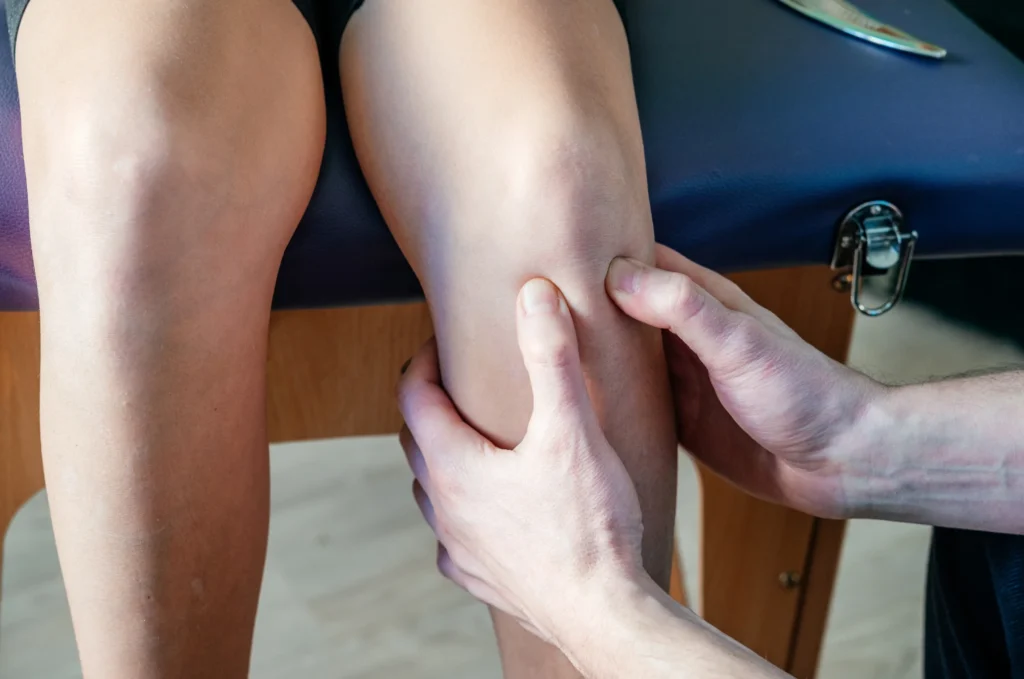
Diagnosis usually starts with a physical exam, not a scan. A physical therapist reviews your pain, recent training, past injuries, work tasks, and goals. Testing may include a range of motion, leg strength, balance, squats, step-downs, and small hops.
The therapist may compare the affected knee and leg with the other side. This can show changes in strength, control, or movement. It also helps guide the first phase of care.
Pain near the kneecap does not always come from the patellar tendon. Other causes include kneecap pain (often called runner’s knee), bursitis, arthritis, meniscus injury, or fat pad irritation. An MRI or ultrasound may help when the cause is unclear, but scan findings alone cannot prove that the tendon is causing the pain.
Patellar Tendinopathy Physical Therapy Interventions
Early care aims to lower painful loads without stopping all movement. You may temporarily reduce running distance, jump volume, squat depth, or sports sessions. Cycling, swimming, or other low-impact exercise may help you stay active.
Treatment then moves from slow strength work to faster tasks. Later phases may include running, jumping, landing, and sport drills. Follow-up visits allow the therapist to assess progress and adjust the plan as pain, strength, and daily function improve.
| Rehab Phase | Main Goal | Common Exercise Examples |
|---|---|---|
| Early phase | Control symptoms and keep the muscles active | Wall sits, Spanish squats, light knee extensions |
| Strength phase | Build quadriceps and tendon strength | Squats, leg presses, split squats, step-downs |
| Faster-load phase | Prepare for a quick force | Low jumps, landings, hops |
| Return phase | Restore sport or work demands | Running, cutting, repeated jumping |
These phases can overlap. Not every person needs every drill, and there is no fixed date for moving forward. Progress depends on symptoms, function, goals, and the day-to-day recovery.
Home exercises are part of tendon healing because the tendon needs consistent practice over time. Manual therapy may ease short-term pain or stiffness, but it does not replace exercise. Graston Technique is one tool-based form of soft tissue work that may be used when it fits a person’s needs.
Patellar Tendinopathy Physical Therapy Exercises
The best exercises for patellar tendon pain depend on the stage of recovery. Early exercises use slow, steady force, while later patellar tendonitis workouts add weight, speed, jumping, and sport-specific tasks. A plan should be built from simple loading to the demands of your daily life or sport.
A common exercise path includes:
- Static holds with little knee movement
- Slow strength work through a safe range
- Jumping, landing, and faster movement
- Sport-specific or activity-specific drills
Isometric Exercises
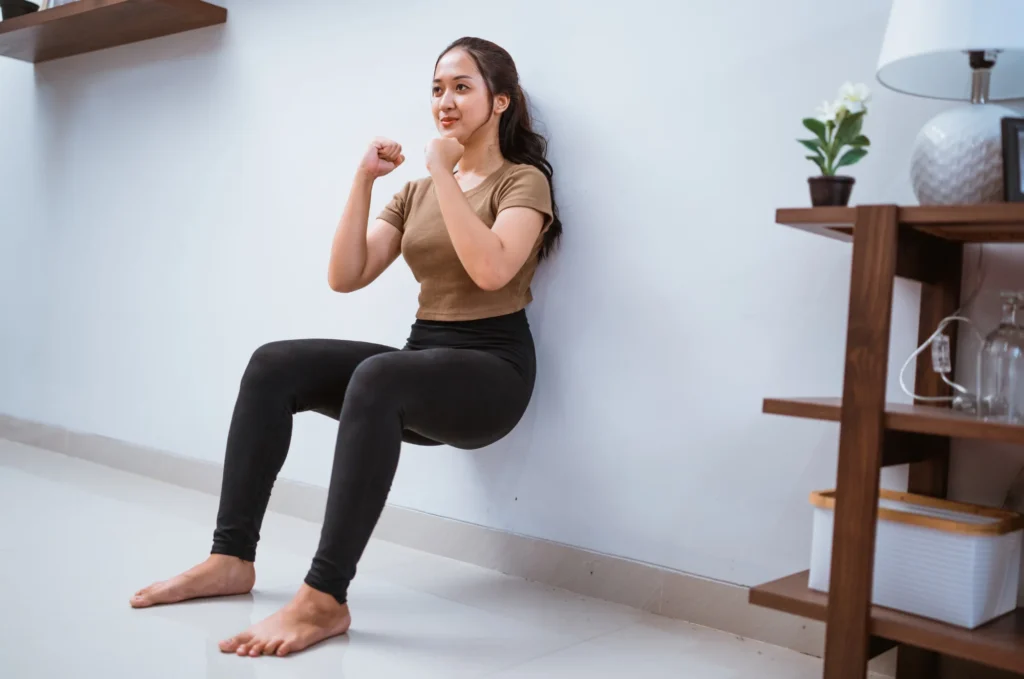
An isometric exercise makes a muscle work without much joint movement. A wall sit is a common starting option. Place your back against a wall, move both feet forward, lower into a comfortable starting position, and hold without bouncing.
A Spanish squat uses a strong strap behind the knees. The strap helps you keep your body upright as the knees bend. Some programs use several holds of about 30 to 45 seconds, but the time and effort should match your current tolerance.
Straight leg raises may keep the thigh muscles active when bending the knee hurts. Lie on your back, bend the other knee, tighten the thigh of the affected leg, and lift the leg while keeping it straight. This exercise places less direct load on the tendon than a squat or knee extension.
Terminal knee extensions use a band placed behind the knee. Start with the knee slightly bent, then straighten it while tightening the thigh. Return with control and keep your foot on the floor.
Slow Resistance Exercises
Slow squats, leg presses, split squats, step-downs, and seated knee extensions are common strengthening exercises. Lower with control, pause, and rise without shifting away from the sore side. One general approach is to use two or three weekly strength sessions, but sets, repetitions, and weight should be adjusted for the individual.
A slow repetition may take about three seconds down, a short pause, and three seconds up. This pace helps control the movement and gives the tendon time under load. Add weight or depth only when the exercise and next-day symptoms stay manageable.
Pilates-based therapeutic exercise may help core strength, hip control, mobility, and smooth movement. It can support direct knee work, but it should not replace tendon loading. Stretching exercises may help relieve tightness in muscles around the hip, thigh, or ankle, though stretching alone will not strengthen the tendons.
Jumping and Athletic Exercises
Jumping starts after slow strength work and daily tasks feel more stable. You may begin with two-leg landings, low jumps, or small hops. Later steps may include one-leg landings, repeated jumps, or changes of direction.
Patellar tendonitis exercises for athletes should be tailored to the sport. A runner may add distance before speed and hills. A volleyball or basketball player may build jump volume in small steps rather than return to a full practice at once.
How Should Exercise Pain Be Managed?
Some pain during treatment of patellar tendon symptoms does not always indicate harm. The pain should stay mild enough for you to use good form and complete the movement with control. Some soreness can occur after exercise, but pain after physical therapy should be judged by its intensity, duration, and effect on normal movement.
Some clinicians use a pain scale to guide exercise, but there is no single safe number for everyone. A mild or moderate level may be acceptable when it settles and does not reduce function the next day. Research and clinical programs often use tolerable pain rather than requiring every exercise to be pain-free.
A clear increase in morning pain, stiffness, or difficulty with everyday tasks may mean the workout was too hard. You can reduce the weight, range of motion, sets, repetitions, speed, or the number of weekly sessions. Change one part at a time so you can see what helps.
Patellar Tendonitis Exercises to Avoid
There is no permanent list of patellar tendonitis exercises to avoid. During a flare-up, repeated jumps, sprints, deep loaded squats, or sudden rises in training may be too much. These tasks may be resumed later, when the tendon can handle more force.
Change an exercise if it causes sharp pain, poor control, or clearly worse pain the next day. The dose may be the problem, not the exercise itself. Full rest may ease pain for a short time, but it does not build strength for future activity.