


At ITNYCPT in New York City, Keith Chan, a New York State-licensed physical therapist, serves as the subject-matter expert for this topic.
This guide explains IT band pain and physical therapy. It covers common exercises and how rehab usually progresses.
Clinician Review: This article was reviewed for clinical accuracy by Keith Chan, New York State-licensed physical therapist.
Key Takeaways
- IT band pain physical therapy focuses on reducing irritation, improving hip strength and movement control, and gradually returning you to activities such as walking or running rather than relying on rest alone.
- Most rehabilitation plans combine activity modification, strengthening exercises, mobility work, and progressive loading because stretching alone is rarely sufficient to resolve IT band syndrome.
- Exercises such as clamshells, side-lying hip abduction, glute bridges, lateral band walks, step-downs, single-leg balance, and hip hikes help improve hip stability and reduce stress on the outer knee.
- Recovery timelines vary, but many mild cases improve in about 4 to 6 weeks, while longer-standing symptoms may require 8 to 12 weeks or more, depending on training load, consistency, and individual factors.
- Seek medical evaluation if symptoms are severe, follow a traumatic injury, cause significant difficulty walking, or do not improve with activity modification and a structured rehabilitation program.
Can Physical Therapy Help IT Band Pain?
Yes. Physical therapy can help many people with IT band pain by addressing the factors that keep the tissue irritated. The goal is not only to calm symptoms, but also to improve how the hip, knee, and foot handle load.
A physical therapist may assess strength, range of motion, training habits, walking and running mechanics, and movement control. Treatment often changes over time as pain decreases and activity increases. This makes IT band PT different from a simple list of stretches or rest instructions.
What Is IT Band Syndrome?
IT band syndrome, also called iliotibial band syndrome, is a common overuse injury that affects the outside of the hip or outer knee.
The IT band is a thick band of connective tissue that runs along the outside of the thigh. It connects with the fascia lata, gluteal muscles, gluteus maximus, and tensor fascia latae.
Pain often occurs with repeated bending and straightening of the knee. This can irritate sensitive tissue near the knee or hip, especially when the body is not ready for the amount of walking or running being performed. Many people describe the problem as band pain on the outside of the leg.
What Causes IT Band Pain?
IT band pain usually comes from repeated load rather than one single event. Running, cycling, hiking, stairs, and long walks can all increase symptoms when the tissue is not ready for the workload. It is one of the common overuse injuries seen in active people.
Muscle weakness can also contribute. Weak hip muscles may allow excessive internal rotation of the hip or knee collapse during walking or running. This can increase stress around the outer knee.
Training Load
Training load refers to the amount of stress your body handles over time. A sudden jump in mileage, hills, speed work, stair use, or long walks around NYC can trigger symptoms. The problem is often not a single workout, but a change in total demand.
Rest may reduce symptoms, but pain can return if the load increases too fast. A rehab plan often rebuilds tolerance in small steps. This helps the knee and hip adapt without repeating the same flare-up cycle.
Hip and Glute Weakness
The gluteal muscles help control the hip and thigh. The gluteus maximus helps extend and stabilize the hip during walking, running, climbing stairs, and squatting. The side hip muscles also help keep the knee aligned over the foot.
When these muscles do not manage load well, the knee may move inward, or the hip may rotate excessively. This does not mean every person with IT band pain has the same weakness. A PT evaluation helps identify which deficits matter for your body and goals, including whether hip joint pain physical therapy exercises may fit into the plan.
Movement Patterns
Movement patterns can affect how stress moves through the leg. A physical therapist may observe squats, step-downs, stairs, walking, or running. The goal is to see how the hip, knee, ankle, and trunk work together.
Small changes in form can reduce irritation. The goal is not perfect movement, but movement that feels controlled and pain-free. Rehab often works best when strength, control, and activity planning improve together.
What IT Band Pain Feels Like
IT band pain often feels sharp, aching, or burning along the outside of the knee. Some people also feel tightness along the outer thigh or hip. Knee pain may start after a certain distance or time has passed.
Symptoms may feel worse with downhill walking, stairs, running, cycling, or repeated bending. Some people feel fine at rest but notice pain once activity reaches a certain threshold. Others feel discomfort with normal daily walking during a flare-up.
When IT Band Syndrome Hurts to Walk
IT band syndrome hurts when walking if the tissue is highly irritated or the load is too much. Pain may appear with each step, especially when the knee bends and straightens. This can make normal errands, commuting, or stairs feel harder.
If walking causes a limp, the activity may need to be reduced temporarily. The goal is to keep useful movement while avoiding repeated flare-ups. Shorter walks, flatter routes, and slower pacing may help during the early stage.
What to Do When Your IT Band Hurts
When your IT band hurts, reduce the activity that triggers symptoms first. This may mean shorter walks, less running, fewer hills, or avoiding stairs when possible. The goal is to lower irritation without stopping all movement.
You do not always need complete rest. Many people do better with modified activity, gentle mobility work, and progressive strengthening. A useful plan should keep you active at a level your symptoms can tolerate.
Activity Changes
Activity changes should match your symptoms. A mild ache that settles quickly is different from sharp pain that gets worse as you move. Pain that lingers into the next day often means the workload was too high.
A simple rule is to keep activity at a level that does not increase pain during or after. You may reduce distance, speed, hills, or workout frequency. You can then rebuild slowly as symptoms become more predictable.
IT Band Stretches for Knee Pain
IT band stretches for knee pain may provide short-term relief. You may feel a stretch along the outside of the hip, thigh, or knee during gentle mobility work. The stretch should feel mild, not sharp or forced.
Stretching alone usually does not solve the problem. The IT band is thick connective tissue, so rehab often works better with stretching and is supported by strength training, movement changes, and load control. Gentle stretching can be useful, but it should not replace strengthening.
When Rest Is Not Enough
Rest can calm pain, but it does not always prepare the leg for activity. Symptoms may return if the same workload resumes without improved strength or control. This is common when someone stops running for a week, then restarts at the same distance.
Structured physical therapy can help by creating a step-by-step plan. A plan can move from pain control to strength, then to return-to-activity training. This approach helps connect symptom relief with real function.
What to Expect From IT Band PT
IT band PT usually starts with a history and movement assessment. The physical therapist may ask when symptoms started, what makes them worse, what has helped, and which activities you want to return to. This helps separate general knee pain from a more specific pattern.
In outpatient physical therapy, care may include testing, education, exercise, manual therapy, and home exercises. At ITNYCPT, sessions are one-on-one and delivered by a licensed Physical Therapist. The plan of care should change as symptoms and function change.
Physical Therapy Assessment
A PT evaluation may include strength testing, mobility checks, balance, squats, step-downs, and gait review. The therapist may also assess the hip, knee, ankle, and lower back. This helps identify whether the pain is mainly related to load, mobility, control, strength, or another factor.
Not every outer knee symptom comes from the IT band. Symptoms can overlap with runner’s knee, patellofemoral pain, meniscus irritation, lateral collateral ligament irritation, hip bursitis, or referred pain from the back. Imaging may be considered when symptoms are severe, unclear, traumatic, or not improving as expected.
Load Management
Load management means adjusting activity so the tissue can recover while staying active. It may include changing distance, speed, terrain, stairs, footwear, cycling resistance, or workout frequency. It is one of the most important parts of ITB syndrome rehab.
Progress depends on symptoms, consistency, sleep, health history, work demands, and your body’s response to exercise. A good plan does not progress only by the calendar. It progresses based on how your knee and hip tolerate each step.
Manual Therapy
Manual therapy may include joint or soft-tissue techniques used to reduce pain and improve mobility. It can support rehab, but it should not replace exercise progression. Soft-tissue work may also include tools such as the Graston Technique when a clinician determines it is appropriate for the case.
Foam rolling is another common tool. A foam roller may help relieve temporary tightness in nearby muscles, but aggressive foam rolling directly over painful tissue can increase irritation. Foam rolling should feel tolerable and not worsen symptoms later that day.
Pilates-Based Exercise
Pilates-based therapeutic exercise may help improve core control, hip control, mobility, and body awareness. These qualities can matter when IT band pain connects to poor load control. Exercises may be modified to reduce strain while still training alignment and control.
This approach can be adapted across rehab phases. Early work may be gentle and focused on control. Later work may challenge balance, strength, and endurance, and may require a return to walking or running.
IT Band Pain Physical Therapy Exercises
IT band pain physical therapy exercises usually focus on hip strength, glute control, balance, and gradual return to load. The exercises should feel controlled and should not sharply increase pain. A physical therapist may adjust reps, resistance, tempo, and range of motion based on your symptoms.
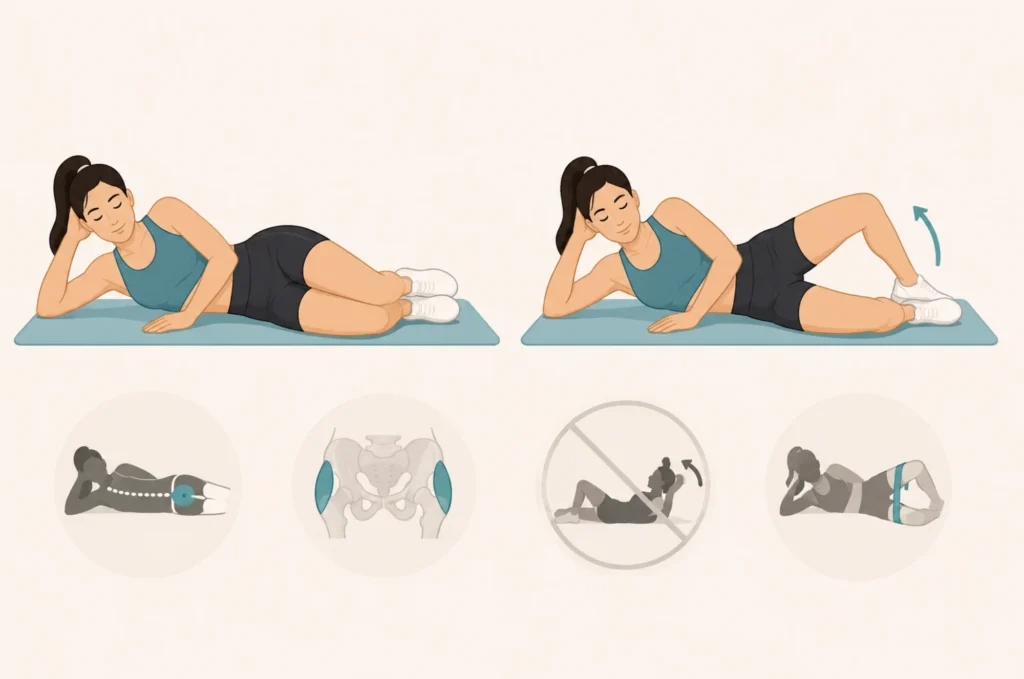
Clamshells
Lie on your side with your knees bent and your feet stacked. Keep your pelvis still, then lift the top knee without rolling backward.
This targets the outer hip and helps train control without placing high stress on the knee. Start with slow reps, then progress with a light resistance band if the movement stays pain-free.
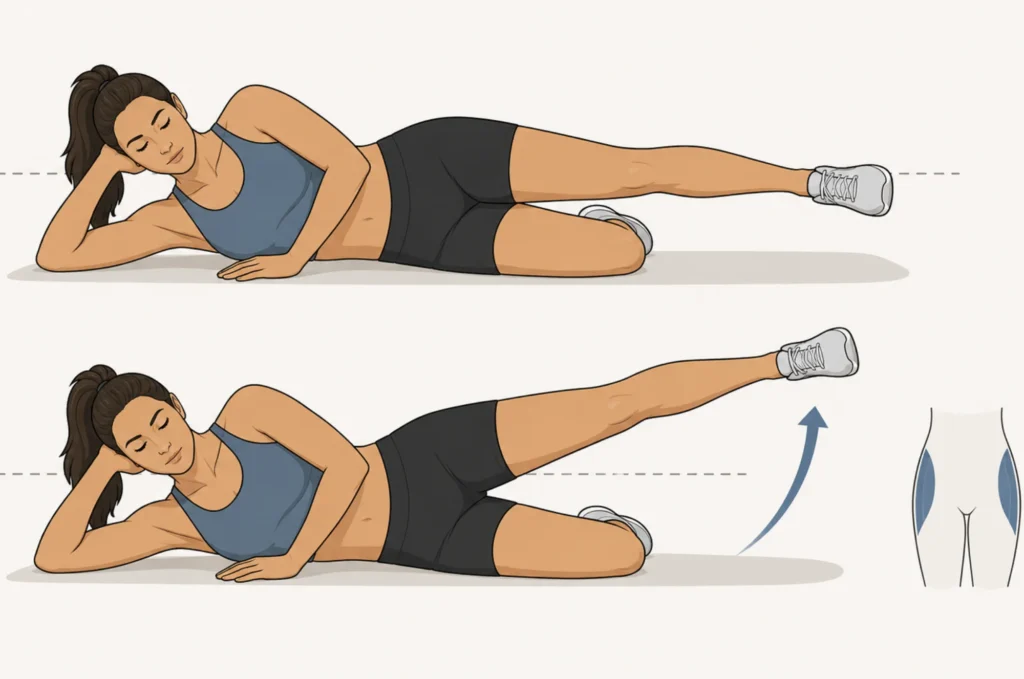
Side-Lying Hip Abduction
Lie on your side with the top leg straight and the bottom knee bent for support. Lift the top leg slightly behind the line of your body, then lower it with control.
Avoid turning the toes upward or rolling the pelvis backward. This exercise targets the side hip muscles that help control the thigh during walking and running.
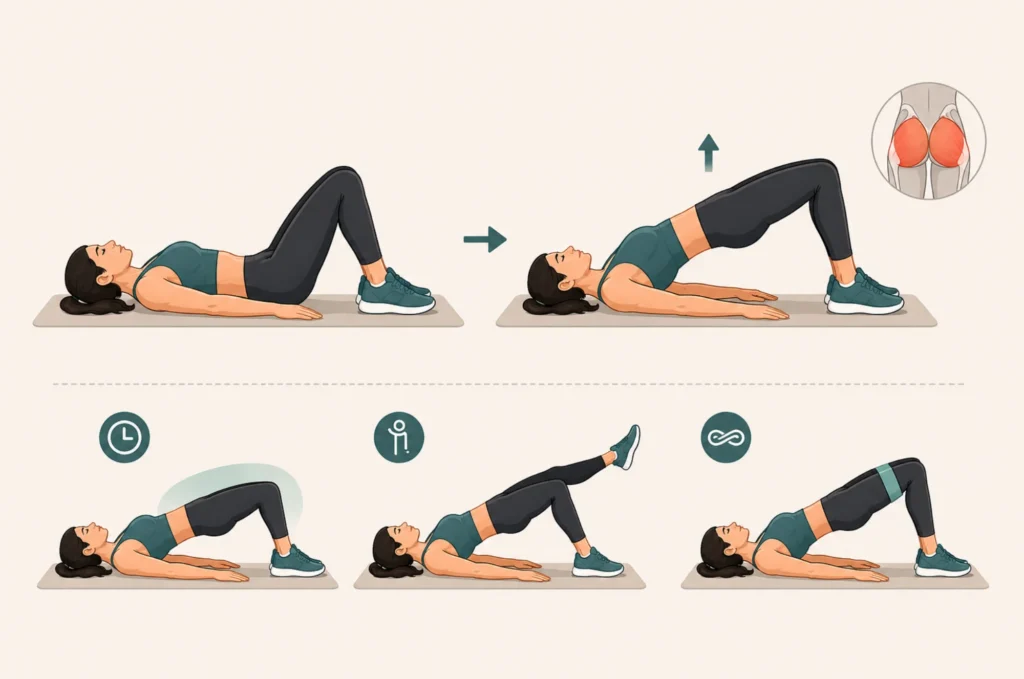
Glute Bridges
Lie on your back, bend your knees, and place your feet hip-width apart. Tighten your glutes, lift your hips, then lower slowly.
This helps train the gluteus maximus without placing high stress on the knees. Progressions may include holds, single-leg bridges, or resistance bands, as tolerated by symptoms.
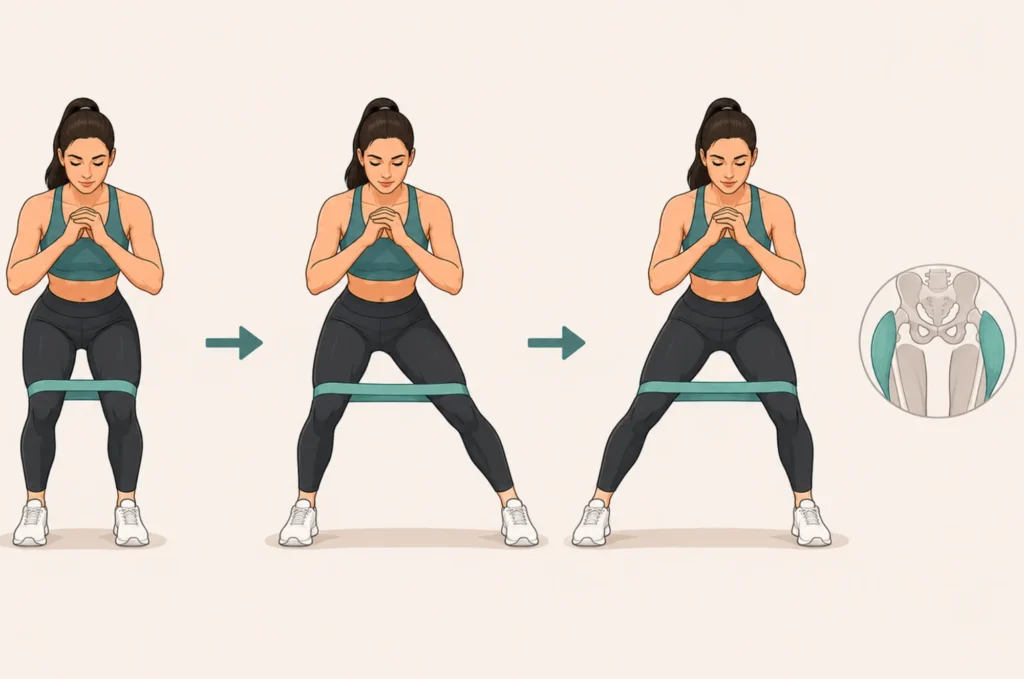
Lateral Band Walks
Place a resistance band around your thighs or ankles. Bend your knees slightly, keep your trunk steady, and take slow steps sideways.
This trains the hip muscles that help prevent the knee from collapsing inward. Keep the steps small and controlled instead of rushing through the movement.
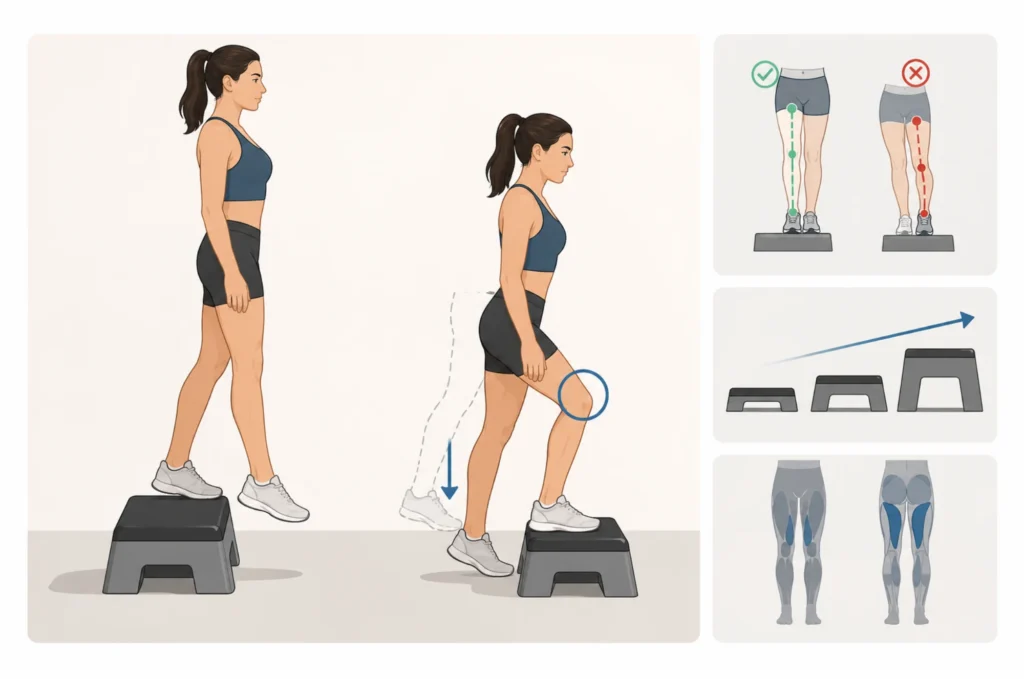
Step-Downs
Stand on a low step and slowly lower one heel toward the floor. Keep the knee aligned over the middle toes as you move.
This exercise trains hip and knee control during bending and straightening. Start with a low height and progress only when the movement stays controlled.
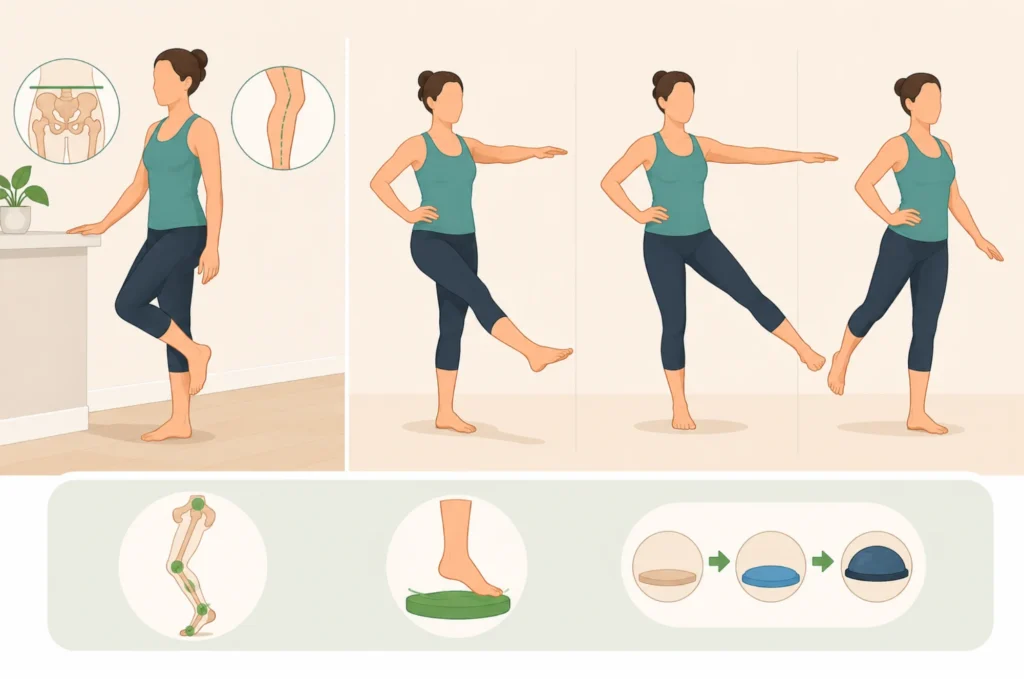
Single-Leg Balance
Stand on one leg near a wall or counter for support. Keep the pelvis level and the knee softly bent.
This exercise helps the hip, knee, ankle, and foot work together. Progressions may include reaching the free leg in different directions or standing on a less stable surface.
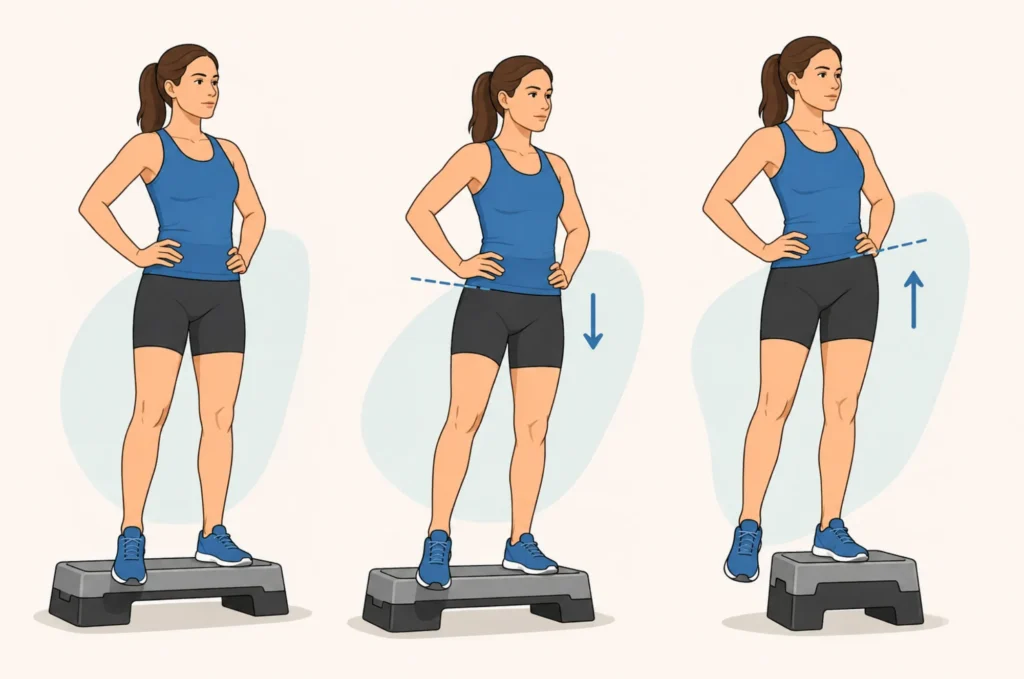
Hip Hikes
Stand sideways on a low step with one foot on the step and the other foot hanging off. Keep the standing knee mostly straight, then gently lower and lift the opposite side of your pelvis.
This trains pelvic control, which can affect how the IT band area handles load. The movement should be small and controlled.
These exercises are not a fixed recipe. Some people need more hip strength, while others need better pacing, mobility, gait changes, or return-to-running progressions. The best exercise plan matches the stage of symptoms and the activity you want to return to.
IT Band Syndrome Exercises to Avoid
IT band syndrome exercises to avoid are usually activities that increase outer knee pain before the tissue is ready. Avoidance is often temporary, not permanent. The goal is to reduce irritation now, then rebuild tolerance later.
Examples may include:
- Long downhill runs when knee pain increases with descent
- Deep squats or lunges that cause sharp outer knee pain
- High-volume stair workouts during a flare-up
- Fast running drills before strength and control improve
- Aggressive foam rolling directly over painful tissue
- Long cycling sessions with high resistance if symptoms increase
- Plyometric drills before walking and basic strengthening feel controlled
These activities may return later in rehab. The timing depends on pain, strength, range of motion, movement control, and tolerance to walking or running. A return-to-activity plan usually works better than guessing.
How ITB Syndrome Rehab Progresses
ITB syndrome rehab often progresses in phases, though the timeline varies for each person. The first phase usually focuses on calming symptoms and reducing the painful load. This may include shorter walks, less running, gentle mobility, and low-irritation strengthening.
The next phase builds strength and control. Exercises may become harder through resistance bands, single-leg work, step-downs, squats, or Pilates-based progressions. The final phase prepares the body for longer walks, running, hills, stairs, sports, or fitness classes.
How Long Does ITB Syndrome Rehab Take?
ITB syndrome rehab timelines vary, but many mild cases improve in about 4 to 6 weeks with consistent activity changes and strengthening.
More persistent cases may take 8 to 12 weeks, especially when symptoms have lasted for months, or walking or running still triggers pain. These are approximations, not fixed recovery rules.
Recovery depends on injury severity, training load, work demands, consistency, pain sensitivity, sleep, and muscle weakness. A gradual plan gives the tissue time to calm down while the hip, knee, and gluteal muscles build better tolerance. Returning too quickly can extend the recovery process.
When to Seek Medical Care
Seek medical care if pain is severe, swelling is significant, walking becomes difficult, or symptoms follow a fall or direct injury.
You should also get evaluated if pain does not improve with basic activity changes. Pain with locking, giving way, numbness, fever, or unexplained swelling should also be assessed.
IT band pain is common, but not every outer knee symptom is caused by the IT band. A proper assessment can help rule out other causes and guide safer next steps. This is especially important when symptoms do not follow the usual pattern of iliotibial band syndrome.