

This article is for education and does not replace an evaluation by a licensed clinician.
Early moves such as diaphragmatic breathing, pelvic tilts, and heel slides keep pressure on your midline low. You avoid anything that makes your belly dome or bulge. Avoid crunches and sit-ups. That ridge often means too much pressure on the gap.
As your control improves, a physical therapist adds hip, arm, and leg strengthening, then load and impact. The plan changes with your history, how long ago you gave birth, and your goals, so timelines range from weeks to months. Exercise can improve core strength and ease symptoms, but the gap does not always close fully.
Keith Chan is a New York State-licensed physical therapist at ITNYCPT in New York City and the subject matter expert for this guide.
Key Takeaways
- Safe diastasis recti exercises start with breathing and deep core activation, then add pelvic tilts, heel slides, toe taps, and glute bridges about three times per week.
- Avoid crunches, sit-ups, and full planks early on, and stop any move that causes doming, pain, pelvic pressure, or leaking.
- A physical therapist confirms the diagnosis and builds a plan that progresses from breathing to strength work, then to running and lifting.
- Exercise can improve core strength and symptoms, but a 2023 review found only a small reduction in gap width, about 0.4 cm, so the gap does not always close.
- Recovery often takes months and varies with severity, time since birth, and consistency. Seek urgent medical care if a bulge is painful, will not flatten when you lie down, or comes with nausea or vomiting.
What Are Safe Core Exercises for Diastasis Recti?
Safe core exercises for diastasis recti start with breathing and deep core activation, then add low-load moves like pelvic tilts and heel slides.
People who search for exercises for abdominal separation diastasis recti usually want a safe place to start. Do these moves about three times per week, and stop any move that causes pain, doming, or leaking.
Top 3 Exercises for Diastasis Recti
Diaphragmatic breathing trains your deep core muscles. Lie on your back with your knees bent and feet flat on the floor, and rest one hand on your rib cage and one on your belly. Breathe in through your nose for four counts as your rib cage widens, then breathe out for four counts while gently drawing your belly button toward your spine. Repeat for 8 to 10 breaths.

Pelvic tilts add gentle movement to that breathing. Lie in the same position, exhale, and tilt your pelvis so your lower back presses lightly toward the floor. Inhale and let your back return to its natural curve, moving slowly for 10 to 12 repetitions.

Heel slides challenge your core while your legs move. Lie with your knees bent and feet flat, exhale, and gently draw your belly button in. Slide one heel along the floor until the leg is nearly straight, then slide it back without letting your lower back arch. Do 8 to 10 slides, then repeat on the other side.

Diastasis Recti Exercises for Beginners
Add toe taps and glute bridges once the first three moves feel easy. Aim for at least three sessions per week and one to two sets of each move. A physical therapist may change these numbers based on your symptoms and history.
Toe taps raise the difficulty. Lie on your back, exhale, and lift one foot, then the other, until both knees sit over your hips at right angles. Lower one toe to tap the floor, bring it back, and alternate legs while your lower back stays still, for 8 to 10 taps per leg.
Glute bridges strengthen your hips while your core stabilizes you. With your knees bent and feet flat on the floor, exhale, tilt your pelvis slightly, and lift your hips until your body forms a straight line from shoulders to knees. Pause for two seconds, lower slowly, and repeat 10 times.

What Is Abdominal Separation (Diastasis Recti)?
Diastasis recti is a widening of the gap between the two rectus abdominis muscles, the paired muscles that run down the front of your belly.
The connective tissues between them, called the linea alba, stretch and thin. Most abdominal separation diastasis recti exercises train your deep core muscles to support that tissue.
Causes and Symptoms
Pregnancy is the most common cause because the growing uterus stretches the abdominal wall. Rapid weight change, abdominal obesity, genetics, and heavy lifting with poor technique also play a role.
If you are pregnant, physical therapy for pregnant women can address core, back, and pelvic concerns during pregnancy.
Common symptoms include a ridge along your midline, low back or pelvic pain, and a weak core. Some people have a gap and no symptoms at all.
Self-Checks and Professional Diagnosis
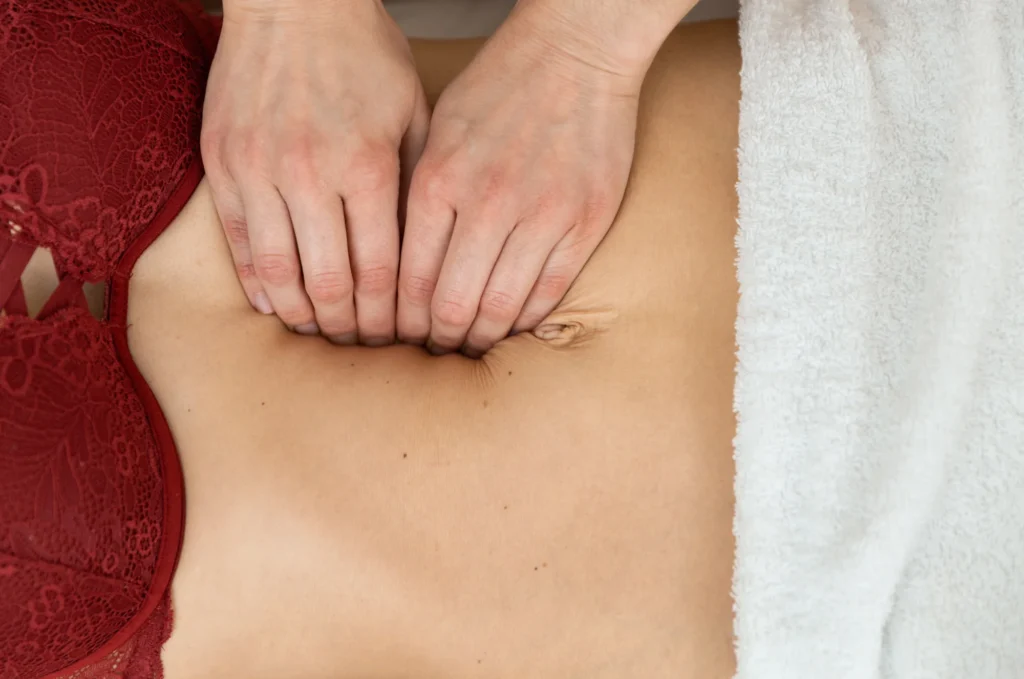
A home screen gives a rough idea, but only a clinician can confirm the result. Lie on your back with your knees bent and feet flat, place your fingertips just above your belly button, and lift your head slightly. Feel for a gap between the muscle edges, then repeat at the belly button and an inch or two below it.
A gap wider than about two finger widths is commonly flagged, but width is only one piece of the picture. A physical therapist reviews your history, feels the gap, and tests breathing, posture, and movement. Goal setting follows, such as returning to lifting or running.
Can Physical Therapy Help Diastasis Recti?
Yes, physical therapy can help diastasis recti by improving core control and easing symptoms. Many people ask whether they can fix diastasis recti with physical therapy, and the honest answer is that results vary. Some gaps narrow, and some stay but stop causing problems.
How Physical Therapy for Abdominal Diastasis Works
Physical therapy for abdominal diastasis starts with a one-on-one evaluation by a licensed physical therapist. The therapist builds an individualized plan of care, reassesses it at set intervals, and sends you home with an exercise program.
Some therapists add manual therapy, a set of hands-on techniques, or Pilates-based exercise. Pilates-based exercise focuses on breathing, control, and alignment.
Pelvic floor therapy can also play a role, since your pelvic floor works with your deep core muscles; you can read more about pelvic floor physical therapy for diastasis recti.
Physical Therapy Exercises for Rectus Diastasis
Physical therapy exercises for rectus diastasis, another name for diastasis recti, change across rehab phases.
The first phase teaches you to engage your deep core muscles through breathing. Later phases add arm and leg movement, then load and impact, once you control your midline without doming.
When to See a Physical Therapist or Doctor
See a physical therapist when a midline bulge, back pain, leaking, or core weakness lingers, or before you return to lifting or running. New York generally allows an evaluation without a referral, with limits on treatment without one.
Seek urgent medical care if a bulge becomes painful, will not flatten when you lie down, or comes with nausea or vomiting, since those signs can point to a hernia.
What Exercises Should You Avoid with Diastasis Recti?
Diastasis recti exercises to avoid are those that push your belly outward or heavily load your midline. This matters most in the first months of rehab. Crunches, sit-ups, and full planks top that list. Your physical therapist can tell you when each move becomes safe again.
Safer Swaps for Common Movements
Exhale during effort in every swap:
- Crunches or sit-ups: pelvic tilts or dead bugs, described below.
- Double leg lifts: heel slides.
- Bicycle crunches: toe taps.
- Full planks or push-ups: wall planks. Stand an arm’s length from a wall, place your hands at shoulder height, and lean in with your body in a straight line.
- Heavy lifting while holding your breath: use lighter loads and exhale as you lift.
Warning Signs During Exercise
Stop, try an easier version, and tell your physical therapist if you notice any of these:
- A ridge or cone shape rising along your midline (doming)
- Pain in your belly, back, or pelvis
- Pelvic pressure or heaviness
- Urine leaking
- Holding your breath or struggling to exhale smoothly

What Is the Best Workout for Diastasis Recti?
The best workout for diastasis recti matches your stage: breathing and deep core activation first, controlled strength second, and impact last.
No single routine fits everyone, since injury severity, time since birth, training history, sleep, and job demands all change the plan. Short, consistent sessions work better than occasional long ones.
Physio Exercises for Diastasis Recti
Physio exercises for diastasis recti follow the same logic as the moves above, and this 15-minute session can strengthen your core for daily tasks such as lifting a child.
Do it three days per week with a rest day in between, and move on only when you finish each set without doming, pain, or leaking. Your physical therapist can add or remove moves as you progress.
- Diaphragmatic breathing: 8 to 10 breaths
- Pelvic tilts: 10 to 12 repetitions
- Heel slides: 8 to 10 per leg
- Toe taps: 8 to 10 per leg
- Glute bridges: 10 repetitions
Progressing from Bird Dog to Running and Lifting
Bird dog is the next step after the beginner set. Start on your hands and knees with your wrists under your shoulders, your knees under your hips, and your spine flat. Exhale, gently draw your belly button in, and slide your right arm forward and your left leg back until both reach hip height. Hold for two seconds, return slowly, then repeat on the other side for 8 repetitions per side.
Dead bugs challenge your core with opposite arm-and-leg movement. Lie on your back with your knees over your hips, bent to a right angle, and your arms pointing at the ceiling. Exhale, lower your right arm overhead and your left heel toward the floor while your lower back stays against the floor, then return and alternate sides for 8 to 10 repetitions each.
Running and heavy lifting come last. A physical therapist typically looks for no doming, leaking, or pelvic pressure during daily tasks and the exercises above before adding impact or load. Progress in small steps, such as walking intervals before running.
Can Exercise Really Fix Diastasis Recti?
Exercise can improve core strength and ease symptoms, but it does not always close the gap completely. Many people hope to heal diastasis recti fully.
A 2023 review of 16 trials found that abdominal exercise reduced gap width by only about 0.4 cm on average, a change the authors did not call clinically meaningful.
The same review noted that exercise may still help with other physical and psychosocial outcomes, so progress is judged by how your core performs.
How Long Does Recovery Take?
Most exercise trials in postpartum women run about 8 weeks, so that is a reasonable window for the first measurable changes. Rebuilding full strength often takes several months, and how long physical therapy takes overall depends on tissue healing and consistency.
Natural recovery has a limit. The gap improves in the first 8 weeks after delivery, but it persists in many women beyond the first year.
A rough timeline looks like this. In the first 8 weeks after birth, you start gentle breathing and deep core work, and some gaps narrow on their own. From about 8 to 20 weeks, structured strength work builds, and gap width and abdominal muscle function tend to improve together. Running and heavy lifting usually come after that, at a pace your physical therapist sets.
Results still vary. Reported prevalence falls from about 60% at 6 weeks postpartum to about 32.5% at 12 months, so roughly one in three women still has a gap after a year. Reviewers rate the evidence for specific exercise programs as very low quality. Severity, time since pregnancy, consistency, health history, sleep, and job demands all change your timeline.
When to Start Postpartum Exercises
Gentle breathing and deep core activation can often start within the first weeks after birth, once your doctor approves. Many clinicians clear structured core exercises around 6 to 8 weeks, but timing depends on your delivery and recovery. A C-section or birth complications can lengthen the wait.
A physical therapist who offers pre- and postnatal rehab can help you time each step.
When Surgery Is Considered
Surgery is an option when rehab has not improved symptoms or when a hernia is present. Guidance often suggests waiting at least six months of consistent rehab before considering it. A surgeon, not a physical therapist, decides whether repair is appropriate.

Common Questions and Myths
Can Diastasis Recti Be Prevented?
Not always, because pregnancy and genetics play a role. Safe core and pelvic floor exercise during pregnancy, approved by your doctor, may reduce the risk or severity. Good lifting technique also helps.
Can Men Get Diastasis Recti?
Yes, men can get it. Common causes include abdominal weight gain, heavy lifting with poor technique, and genetics. The same principles of breathing, deep core activation, and gradual progression apply.
Is Pilates Safe with Diastasis Recti?
Pilates can be safe when an instructor or physical therapist modifies it. Early on, skip movements that curl your trunk forward, such as roll-ups and the hundred. Tell your instructor about your diagnosis before class.
Common Myths About Diastasis Recti
Myth one says sit-ups close the gap, but they load the midline and often cause doming. Myth two says a wider gap always means worse symptoms, but function and control matter more than width. Myth three says only mothers get diastasis recti, but men and others can too.
References
- GoodRx. “11 Best Exercises for Diastasis Recti and Increased Core Strength.” Updated September 4, 2025. https://www.goodrx.com/well-being/movement-exercise/diastasis-recti-exercises
- Choose PT, APTA Pelvic Health. “Physical Therapy Guide to Diastasis Rectus Abdominis.” Expert-reviewed 2020. https://www.choosept.com/guide/physical-therapy-guide-diastasis-rectus-abdominis
- Benjamin DR, Frawley HC, Shields N, et al. Conservative interventions may have little effect on reducing diastasis of the rectus abdominis in postnatal women: a systematic review and meta-analysis. Physiotherapy. 2023;119:54-71. https://pubmed.ncbi.nlm.nih.gov/36934466/
- Benjamin DR, van de Water ATM, Peiris CL. Effects of exercise on diastasis of the rectus abdominis muscle in the antenatal and postnatal periods: a systematic review. Physiotherapy. 2014;100(1):1-8. https://pubmed.ncbi.nlm.nih.gov/24268942/
- Gluppe S, Engh ME, Bø K. What is the evidence for abdominal and pelvic floor muscle training to treat diastasis recti abdominis postpartum? A systematic review with meta-analysis. 2021. https://pubmed.ncbi.nlm.nih.gov/34391661/
- Gluppe SL, Hilde G, Tennfjord MK, Engh ME, Bø K. Effect of a postpartum training program on the prevalence of diastasis recti abdominis in postpartum primiparous women: a randomized controlled trial. Phys Ther. 2018;98(4):260-268. https://pubmed.ncbi.nlm.nih.gov/29351646/
- Thabet AA, Alshehri MA. Efficacy of deep core stability exercise program in postpartum women with diastasis recti abdominis: a randomized controlled trial. J Musculoskelet Neuronal Interact. 2019;19(1):62-68. https://pubmed.ncbi.nlm.nih.gov/30839304/
- Kamel DM, Yousif AM. Neuromuscular electrical stimulation and strength recovery of postnatal diastasis recti abdominis muscles. Ann Rehabil Med. 2017;41(3):465-474. https://pubmed.ncbi.nlm.nih.gov/28758085/
- Keshwani N, et al. Relationship between interrectus distance and symptom severity in women with diastasis recti abdominis in the early postpartum period. Phys Ther. 2018;98(3):182-190. https://pubmed.ncbi.nlm.nih.gov/29228344/
- Coldron Y, Stokes MJ, Newham DJ, Cook K. Postpartum characteristics of rectus abdominis on ultrasound imaging. Man Ther. 2008;13(2):112-121. https://pubmed.ncbi.nlm.nih.gov/17208034/
- The relationships between inter-recti distance measured by ultrasound imaging and abdominal muscle function in postpartum women: a 6-month follow-up study. https://pubmed.ncbi.nlm.nih.gov/21289454/