

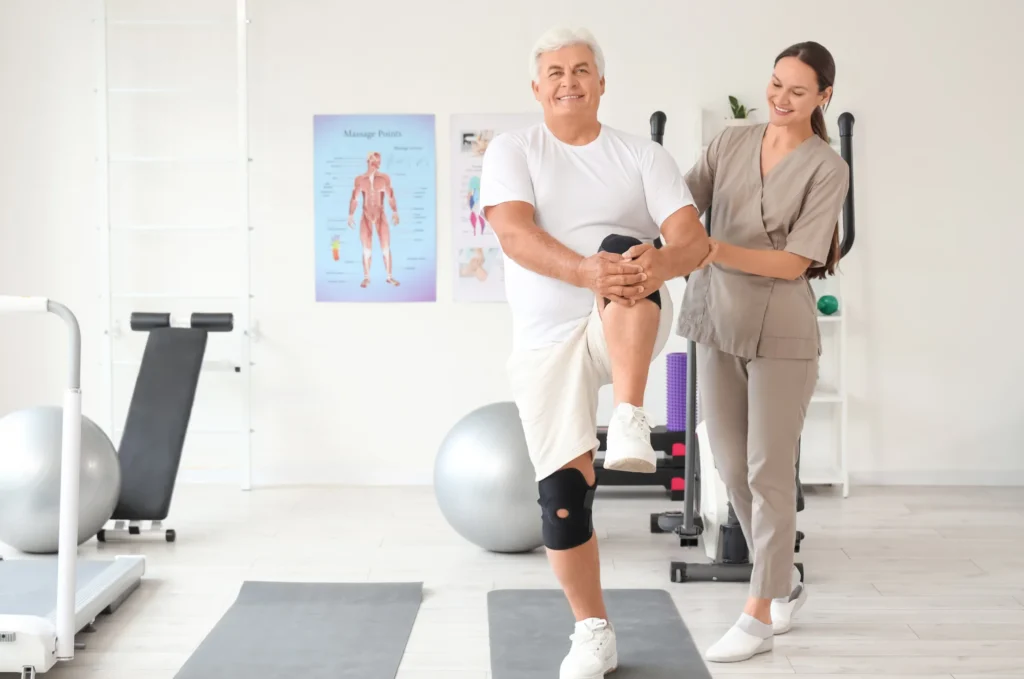
Therapists help ease chronic pain from arthritis or back problems with exercise and manual therapy. This may reduce the need for pain medication. They restore function after joint replacement, a fracture, or a stroke. They also support conditions like Parkinson’s disease or heart disease.
Regular physical activity is also linked to better mood and thinking skills, including lower anxiety and depression. Group sessions can build confidence and reduce isolation.
ITNYCPT, an outpatient clinic in New York City with a Financial District location, prepared this guide with Keith Chan, a New York State licensed physical therapist, as the subject matter expert.
Key Takeaways
- Physical therapy helps older adults lower fall risk, ease pain, regain strength, and keep daily routines. Results vary with health history and effort.
- Balance, gait, and leg strength training are central to fall prevention. The Otago Exercise Program has reduced falls by about 35% in frail, high-risk older adults.
- Most seniors attend about 6 to 12 weeks of therapy, with one to three visits a week. Recovery after a joint replacement or fracture can run longer.
- Medicare covers as many outpatient physical therapy sessions as are medically necessary, with no fixed visit limit. In 2026, you pay 20% after the $283 Part B deductible, and a medical necessity review applies once physical therapy and speech-language costs reach $2,480 combined.
- New York allows a physical therapist to treat without a referral for 10 visits or 30 days, whichever comes first. Sudden one-sided weakness, trouble speaking, or chest pain needs urgent care, not physical therapy.
Main Benefits of Physical Therapy for Elderly Adults
Physical therapy helps older adults lower fall risk, ease pain, regain strength, and maintain daily routines. Licensed physical therapists first assess movement, then match exercises to their findings. Outcomes depend on health history and effort.
How Physical Therapy for the Elderly Prevents Falls
Physical therapy for older people lowers fall risk by training balance, leg strength, and walking patterns. A therapist screens for weak muscles, slow reactions, and unsafe habits, then uses standing and stepping drills.
Fall prevention works best when balance training gets harder as control improves, which supports reducing the risk of falls over time.
Less Pain and Stiffness
Physical therapy can reduce pain by restoring range of motion and strengthening the muscles around a sore joint.
Therapists combine exercise, hands-on techniques, and activity changes, so care does not rely on medication alone. This suits chronic pain from arthritis or old injuries, though pain can still shift from day to day.
Strength, Mobility, and Independence
Strength training helps seniors maintain mobility and independence for tasks like climbing stairs, rising from a chair, and carrying groceries.
Improving mobility often starts with the hips and legs, because those muscles drive standing and walking. Regular physical activity keeps those gains and supports an active lifestyle.
Recovery After Surgery or Injury
Physical therapy guides recovery after surgery or injury in stages. After a joint replacement, early sessions protect the joint and control swelling, while later sessions rebuild strength and walking ability. The surgeon’s instructions set the limits.
What the Research Shows
Research supports exercise-based therapy for older adults, especially for balance, strength, and physical function. The best-studied example is the Otago Exercise Program, which pairs strength and balance exercises with a walking plan.
Researchers in New Zealand developed it, and studies show that it reduces falls by about 35% in frail, high-risk older adults.
The National Council on Aging reports a 35 to 40% reduction and recommends that a physical therapist assess frail adults and prescribe their starting exercises. Results vary by person, and the evidence is strongest for supervised programs kept up over the long term.
Conditions Elderly PT Can Help With
Elderly PT addresses movement problems caused by joint, bone, nerve, and balance conditions. Therapists treat how a condition affects movement and coordinate with the person’s doctor. Common examples include:
- Arthritis and chronic joint pain
- Osteoporosis, with exercise matched to bone strength
- Parkinson’s disease, with training for walking and posture
- Stroke recovery, with work on strength, balance, coordination, and issues like foot drop
Occupational therapy often works alongside physical therapy. Physical therapists focus on walking, strength, and balance. Occupational therapists focus on daily tasks like dressing and cooking.

What Geriatric Physical Therapy Rehabilitation Involves
Geriatric physical therapy rehabilitation is care tailored to older adults’ health needs, from initial evaluation to follow-up. Sessions are one-on-one with a licensed physical therapist. The plan changes as the person progresses.
Evaluation and Treatment Plan
An evaluation covers health history, goals, and tests of strength, range of motion, and balance. The plan of care sets visit frequency, exercises, and reassessment dates.
Therapeutic exercise changes by phase, from safe movement early on to added load later, while home exercises carry the work between visits.
Treatment Types for Older Adults
Treatment can combine therapeutic exercise, manual therapy, and Pilates-based exercise. Manual therapy means hands-on techniques, such as joint mobilization and soft tissue work, that can ease stiffness before exercise.
Pilates-based therapeutic exercise builds core strength, control, and mobility. Keith Chan is a Graston Technique provider, a tool that fits only when a soft tissue restriction is present.
Physiotherapy for Geriatrics Versus Physical Therapy
Physiotherapy for geriatrics and physical therapy describe the same profession applied to older adults. The difference between physiotherapy and physical therapy is mostly regional: “physiotherapy” is common in the UK and Canada, while “physical therapy” is standard in the United States. A geriatric focus means training in age-related changes, not a separate license.
Elderly Physical Therapy Exercises
Elderly physical therapy exercises mainly train balance, leg strength, and flexibility. A therapist chooses them after testing and gradually increases the difficulty. Two common examples follow.
Balance and Strength Exercises
The sit-to-stand drill builds the leg strength needed to rise from a chair. Sit near the edge of a sturdy chair, stand without pushing off with your hands, and sit back down slowly. Calf raises train the lower leg muscles that steady the ankle while you walk. A therapist can check form and set repetitions that fit your health history.
How Often Should a 70-Year-Old Exercise
Federal guidelines suggest adults 65 and older aim for about 150 minutes of moderate physical activity weekly, muscle-strengthening on two or more days, and balance activities.
A 70-year-old can split that into short sessions. People with health conditions may need to start with lower targets.
Physical Therapy for Elderly at Home
Physical therapy for older people at home usually means a home exercise program taught during clinic visits. Short daily sessions of 10 to 15 minutes often fit routines better than one long session. A stable setup, such as a counter within reach, keeps the work safe.
How Long Does Physical Therapy Take for Seniors
Most seniors attend physical therapy for about 6 to 12 weeks, usually one to three visits a week. A balance and strength program often fits that range.
Recovery after a joint replacement or fracture can run longer, while a minor strain may resolve in a few weeks. Chronic conditions such as arthritis or Parkinson’s disease may call for periodic care over the long term.
Injury severity, health history, starting strength, pain sensitivity, sleep, and consistency with home exercises all change the pace. Reassessments at set intervals show whether to continue, adjust, or end care. A routine maintained after discharge, such as a home program or personal training, helps protect gains.
How Many PT Sessions Does Medicare Cover

Medicare covers as many outpatient physical therapy sessions as are medically necessary, with no fixed visit limit. Part B pays for this care.
A doctor or other eligible provider must determine that the therapy is medically necessary. In practice, your plan of care and your progress set the number of visits.
In 2026, once yearly physical therapy and speech-language pathology costs reach $2,480 combined, the provider must confirm that care is still medically necessary. That step is a review, not a block on needed care. Medicare Advantage plans may have their own rules, so check yours.
Insurance Terms Explained
A deductible is what you pay before coverage starts, and coinsurance is your percentage share of each approved charge. After you pay the 2026 Part B deductible of $283, Medicare pays 80%, and you pay 20%.
A copay is a flat per-visit fee, and out-of-network means the provider has no contract with your plan. Ask your insurer about visit limits and your cost per visit.
Do You Need a Referral in New York
New York allows a physical therapist with three years of experience to treat without a referral for 10 visits or 30 days, whichever comes first.
The patient completes a Notice of Advice form explaining that insurance may not cover treatment without a referral. Some insurers still require a referral before they pay, so confirm your plan’s rule first.
When Should Seniors See a Physical Therapist
Seniors should see a physical therapist when pain, weakness, or unsteadiness starts to limit daily activity. Early evaluation lets a therapist address small changes before they grow. A primary care doctor can also recommend therapy.
Signs It Is Time to See a PT
Small changes in movement often come first. No single sign confirms a problem, but several together deserve a closer look. Common signs include:
- You steady yourself on furniture or walls
- You avoid stairs because you fear falling
- Standing up takes effort or more than one try
- You had a recent fall or near fall

When to Seek Urgent Care
Seek urgent care right away for sudden one-sided weakness, facial drooping, trouble speaking, or chest pain, and call 911 for these signs. Go to an emergency room after a fall if you hit your head, cannot bear weight, or have severe pain. Physical therapy is not the first step for these problems.
Frequently Asked Questions
Is It Too Late to Start After 80
It is rarely too late to start. Older adults in their 80s and beyond can build strength and improve balance with exercise. A therapist adjusts load and rest to fit health conditions.
Does Exercise Make Pain Worse
Mild soreness after new exercise is common and often fades within a day or two. Sharp, worsening, or lasting pain is different, so stop and tell your therapist. The therapist then adjusts the plan.
Sources
- edicare.gov, Physical Therapy Services and Medicare Coverage of Outpatient Therapy (publication 10988)
- Medicare.gov, 2026 Medicare Costs: https://www.medicare.gov/publications/11579-medicare-costs.pdf
- CMS, Therapy Services (KX modifier thresholds): https://www.cms.gov/medicare/coding-billing/therapy-services
- CMS, Medicare Deductible, Coinsurance and Premium Rates, CY 2026: https://www.cms.gov/files/document/mm14279-medicare-deductible-coinsurance-premium-rates-cy-2026-update.pdf
- Medicare Interactive, Outpatient Therapy Costs
- New York State Education Department, Office of the Professions, Provision of Physical Therapy Services and Payment and Physical Therapy
- National Council on Aging, Otago Exercise Program: https://www.ncoa.org/article/evidence-based-program-otago-exercise-program/
- Frontiers in Public Health (2017), The Otago Exercise Program: https://www.frontiersin.org/articles/10.3389/fpubh.2017.00054/full
- U.S. Department of Health and Human Services, Physical Activity Guidelines for Americans