

At ITNYCPT, a physical therapy clinic in New York City, Keith Chan handles this evaluation. He is a New York State licensed physical therapist. He has worked with many patients for over ten years.
This article explains the exercises. It also shows how they differ for men and women. It explains what to expect if home exercises aren’t enough.
Key Takeaways
- Pelvic floor exercises fall into two categories: strengthening moves like Kegels, bridges, and squats, and relaxation techniques like diaphragmatic breathing and reverse Kegels. Using the wrong category for your symptoms, such as Kegels on an already tight pelvic floor, can make symptoms worse.
- Pelvic floor dysfunction affects men and women and can cause urinary or bowel incontinence, pelvic pain, and discomfort during sexual activity. Weakness, tightness, and poor muscle coordination are distinct causes that require different exercise approaches.
- Mild symptoms often respond to a home routine, but severe pain, ongoing incontinence, or symptoms lasting more than a few weeks usually call for a licensed pelvic floor physical therapist.
- A pelvic floor therapy evaluation typically starts with a history and movement screen, and an internal exam may be offered but is always optional and based on patient consent.
- Most patients attend six to eight therapy sessions before seeing meaningful improvement, though results depend on symptom severity, consistency, and overall health history.
Most Effective Pelvic Floor Physical Therapy Exercises
The most effective pelvic floor exercise depends on the problem you’re addressing. If your pelvic floor exercises target weakness, physical therapists typically start with Kegel exercises and bridge-style movements to strengthen the pelvic floor.
If the issue is tightness rather than weakness, relaxation exercises often help more than strengthening alone. Diaphragmatic breathing and reverse Kegels are good options. A pelvic floor physical therapist can help determine which category applies before you begin a routine.
Pelvic Floor Exercises Step by Step
These exercises are commonly recommended to strengthen your pelvic floor. You can do each one at home without special equipment, though proper form matters more than the number of repetitions.
They are not a substitute for a professional evaluation, but they offer a safe starting point for many people building pelvic floor exercises into a daily routine.
- Kegel exercises: Contract the pelvic floor muscles as if you were stopping urine midstream. Hold for 3 to 5 seconds, then release for 3 to 5 seconds. Repeat 10 to 15 times, three times a day.

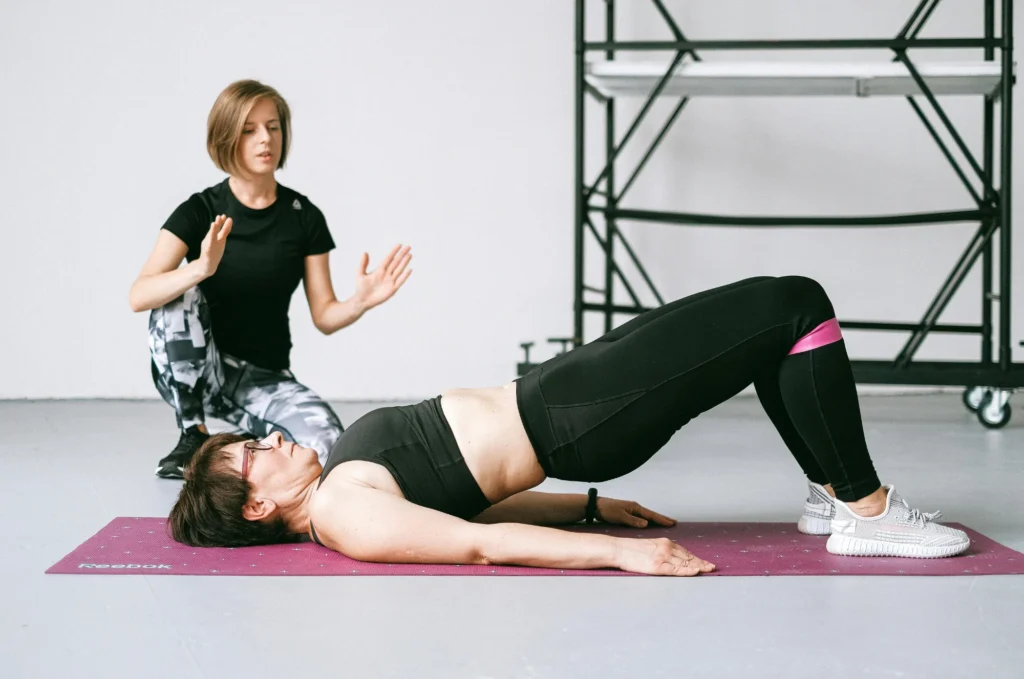
- Bridge exercise: Lie on your back with knees bent and feet flat on the floor. Engage your core and pelvic floor, lift your hips into a straight line from shoulders to knees, hold briefly, then lower. Repeat 10 to 15 times.

- Squats: Stand with feet shoulder-width apart. Lower your hips as if sitting into a chair, then return to standing while squeezing your glutes and pelvic floor. Repeat 10-15 times with controlled form.

These three movements cover most of what is recommended for building pelvic floor strength. Consistency matters more than intensity.
These are small muscles. They respond best to repeated, controlled effort, rather than heavy loads. A treatment plan built around your specific symptoms will usually adjust repetitions, hold time, and added resistance as your strength improves.
Pelvic Floor Physical Therapy Exercises to Relax
When muscles are tight rather than weak, pelvic floor relaxation exercises, such as diaphragmatic breathing or a reverse Kegel, are usually the better choice.
Signs that point toward a tight pelvic floor include pelvic pain, discomfort during intercourse, a sense of pressure, or difficulty fully emptying the bladder or bowel. In worse cases, Kegel exercises can worsen symptoms because the muscles are already overactive.
Diaphragmatic breathing is one of the simplest ways to relax your pelvic floor. Lie on your back with your knees bent, place a hand on your stomach, and breathe slowly through your nose so your belly rises instead of your chest. Exhale slowly while consciously releasing tension around the pelvis, and repeat for five to ten breaths.
You can combine a reverse Kegel, which gently lengthens the pelvic floor instead of contracting it, with this breathing pattern for a faster release when the area feels tense.
What Is Pelvic Floor Dysfunction and Why It Happens
Pelvic floor dysfunction occurs when the muscles that support the bladder, bowel, and reproductive organs become too weak, too tight, or poorly coordinated to work properly.
Pelvic floor dysfunction physical therapy addresses this by evaluating the involved muscles and creating a plan to retrain them.
These muscles control urination and bowel movements and play a role in sexual function, so a breakdown in any of these areas can affect several systems at once.
Pregnancy, childbirth, surgery, chronic straining, and aging are among the most common contributors to this kind of pelvic floor disorder. A pelvic floor disorder is not exclusive to women, and men experience pelvic floor issues as well, often tied to prostate surgery or long-term muscle tension.
Common Signs of Pelvic Floor Dysfunction
Pelvic floor dysfunction can show up in different ways depending on whether the muscles are weak or tight. Common signs include:
- Urinary incontinence or leaking urine during activity, coughing, or sneezing
- Difficulty with bladder control, including urgency or frequent urination
- Pelvic pain or a feeling of heaviness in the pelvis
- Trouble controlling bowel movements or passing gas
- Discomfort during sexual activity
These symptoms often overlap, and having one does not necessarily mean the others will follow. A pelvic floor physical therapist evaluates which muscles are involved and whether the pattern points toward weakness, tightness, or a coordination problem. That assessment shapes the treatment plan.
Is It Safe to Do Pelvic Floor Therapy at Home
Yes. You can often start pelvic floor physical therapy exercises at home, especially for mild symptoms like occasional urgency or general weakness.
Kegels, bridges, and basic breathing work are generally considered safe to try without supervision. Poor form or using the wrong exercise for your specific issue can still delay progress or worsen symptoms.
Can You Do Pelvic Floor Therapy on Your Own
In many cases, yes: mild symptoms can improve with a steady home routine, especially when general weakness, not pain, is the main issue.
Pelvic floor exercises work best with guidance after an initial evaluation. Many people tighten the wrong muscles or overdo routines aimed at the wrong pattern.
A short consultation with a pelvic floor physical therapist can confirm whether your symptoms fit a strengthening approach or a relaxation approach before you invest weeks in a routine.
When Home Exercise Isn’t Enough
Home exercise often isn’t enough. This is true with severe pain, ongoing urinary incontinence, or pelvic floor issues lasting more than a few weeks. At that point, a licensed clinician can use manual therapy, biofeedback, or electrical stimulation to address muscle patterns that exercise alone cannot reach.
A structured treatment plan, based on an initial evaluation, often gives more consistent results than a self-guided routine. This is especially true for moderate-to-severe symptoms.

Pelvic Floor Physical Therapy Exercises for Women
Women’s pelvic floor therapy often focuses on changes related to pregnancy, childbirth, or menopause, all of which can weaken or alter the surrounding muscles.
Along with Kegel exercises, physical therapists frequently recommend core and hip work, since these muscle groups work together with the pelvic floor to support posture and movement.
Some clinics use Pilates-based therapeutic exercise to build core strength, control, and mobility alongside direct pelvic floor training.
Postpartum patients are often advised to begin gently and progress gradually, since tissue healing after childbirth takes time regardless of how strong the pelvic floor was beforehand.
Pregnancy can also strain the pubic joint directly, a separate but related issue known as pubic symphysis dysfunction.
For women experiencing urinary incontinence or pelvic organ prolapse symptoms, pelvic floor strengthening is usually paired with guidance on safe lifting, posture, and breathing during exertion.
A pelvic floor physical therapist adjusts the pace of progression based on symptoms rather than a fixed timeline.
Pelvic Floor Physical Therapy Exercises for Men
Pelvic floor physical therapy exercises for men typically start with Kegels and pelvic tilts, even though a tight pelvic floor can cause symptoms as much as a weak one. Men can have pelvic floor problems too, often after prostate surgery or from chronic pelvic pain.
They can also come from long periods of unconscious muscle tension.
That is why an evaluation matters before starting a routine. Kegel exercises can help with urinary incontinence in men, but using them on an already-tight pelvic floor can worsen symptoms rather than improve them.
Pelvic tilts are a straightforward starting exercise: lie on your back with knees bent, gently flatten your lower back into the floor by tightening your core, hold for 5 to 10 seconds, then release. Repeat 10 to 15 times, focusing on slow, controlled movement rather than speed.
How to Relax Pelvic Floor Muscles in Men
Relaxing the pelvic floor muscles in men usually starts with recognizing that constant clenching, often unconscious during sitting or stress, contributes to tension. A gentle reverse Kegel, paired with slow diaphragmatic breathing, can help release this tension over several minutes.
Men experiencing persistent pelvic pain, discomfort during sexual activity, or difficulty relaxing the area despite consistent practice should consult a pelvic floor physical therapist rather than continuing to self-treat.
What to Expect at Pelvic Floor Therapy
Pelvic floor therapy: what to expect usually starts with a conversation, not a physical exam. Sessions are typically one-on-one with a licensed physical therapist, allowing the plan to adjust as your body responds over time.
Most pelvic floor physical therapists start with a detailed history of bladder and bowel habits, pain patterns, and any prior surgery or childbirth, followed by a movement screen to assess posture, core strength, and hip mobility.
From there, therapists set goals collaboratively and build a treatment plan around what the evaluation reveals.

Your First Visit and What Happens Next
The first visit typically focuses on gathering information and establishing a baseline rather than starting treatment right away. Many clinics schedule weekly therapy sessions afterward. They combine supervised exercise with manual therapy techniques.
These may include soft tissue work, such as the Graston Technique. Clinicians use this when tension or scar tissue worsens symptoms. Clinicians usually assign home exercises between sessions, since consistency between visits often matters as much as the sessions themselves.
Most insurance plans with physical therapy benefits also cover pelvic floor physical therapy. Coverage details vary by plan, including copay amounts and whether a physician referral is required. Confirm these details with your insurance provider before your first visit.
Some plans also limit the total number of therapy sessions covered per year, which can factor into how a treatment plan is paced.
Does Pelvic Floor Therapy Involve an Internal Exam
Yes, a therapist may offer an internal pelvic exam as part of a full evaluation because it lets them assess muscle tone, coordination, and tenderness directly. It is always optional, requires the patient’s consent, and isn’t required for every visit or every patient.
Many patients begin with an external evaluation only and decide later, once they feel comfortable, whether to proceed with an internal assessment.
How Long It Takes to See Results
Many patients attend six to eight therapy sessions before noticing a meaningful change. However, results vary depending on symptom severity, consistency between sessions, and whether the underlying issue is weakness, tightness, or both.
Some patients improve earlier, while others need a longer treatment plan. Health history, stress levels, and general activity level can all influence how quickly the pelvic floor responds to therapy.